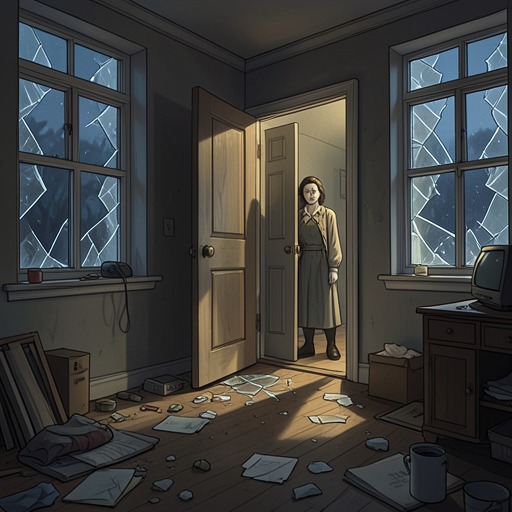
Karsten Sundelin—Lily Sundelin
The CallerKarsten Sundelin and Lily Sundelin’s relationship moves from an attraction Karsten remembered as sensuous and sustaining to a marriage marked by exhaustion, failed attempts at intimacy, and separation. In the aftermath of an incident involving Margrete Sundelin, Karsten feels unable to protect his family, while the work of caring for their daughter and the strain between the adults narrow the space they share. Their eventual separation gives physical form to a fracture that Karsten had already experienced as spreading through the foundations of his life.
Attraction, Marriage, and Family
Looking back on their beginnings, Karsten remembers being drawn to Lily’s French roots and the French language she whispered to him. Its meaning was not always clear to him, but the sound and intimacy of it stirred his anticipation. He also recalls Lily as petite and beautiful, moving with the grace of a goldfish gliding through water. These images make his remembered love vivid, but they belong to his account of the relationship: the French language and Lily’s appearance are the features he names when asking himself why he fell in love.
His explanation of their marriage is less romantic. They had been together for a long time, were adults, and marriage seemed the natural next step. He also remembers being alone and needing someone; he felt that his parents and friends saw his sorrow and could not bear to watch it. In retrospect, the decision appears to him as a mixture of attachment, circumstance, and need rather than a choice whose motives he had fully examined.
The same uncertainty enters his thoughts about Margrete. Karsten wonders whether he and Lily had properly considered having a child or simply treated it as inevitable. He projects his questions forward, imagining Margrete at fifteen, thirty, and forty, and asking whether her future success—or failure—would be his responsibility. His questioning shows how the parental bond intensifies his sense of obligation, even as he wonders how he can escape the burden he feels. It also connects the state of the marriage to his fear that he has failed both Lily and their daughter.
The Marriage After the Incident
The incident involving Margrete changes Karsten’s experience of the household. He believes that he failed to protect his family and that an outsider shattered the relationship. The damage appears to him not as a single quarrel but as small fractures continuing to widen until his life seems close to collapse. His temper grows sharper; he moves and gestures testily, and he slams doors harder. These physical changes make the strain visible even when he does not describe it directly to Lily.
Karsten’s feelings toward his wife also shift. At times, especially when drinking in the evening, he admits to himself that he no longer loves Lily and has begun to dislike her. He says to himself that he cannot cope with her femininity, fear, and vulnerability; immediately, however, despair follows, because he suspects he may be the one who has failed them. His resentment and self-reproach therefore remain bound together. The narrative presents neither feeling as a settled verdict on Lily: both are part of Karsten’s troubled, self-questioning response to the family’s crisis.
His response is often to find a task that will absorb his energy. He secures loose boards in the garden fence, hammers nails, or chops wood with an axe until chips fly. These practical jobs give his agitation somewhere to go, but they do not resolve the marital estrangement. Lily watches him through the window, while her attention is largely occupied by Margrete. The two adults are thus shown in the same domestic space but turned toward different demands: Karsten works off his anger outside, and Lily concentrates on the child.
Intimacy, Care, and Withdrawal
Karsten begins going out for drinks after work, stopping at a friend’s home or having a beer at the small bar beside the Shell station in Bjerkås. He sometimes returns late by taxi, drunk, yet sees no sign that Lily is irritated. He interprets her lack of visible response through her absorption in caring for Margrete. The detail does not establish what Lily privately feels; it shows the distance between them as Karsten perceives it, with his late returns meeting neither a confrontation nor a renewed closeness.
At night, the three lie in the same bed with Margrete between her parents. Karsten sometimes reaches carefully to touch Lily’s shoulder or hair, repeating a gesture that had once been habitual. Lily responds with an involuntary shudder, as if his touch irritates her. The smallness of the gesture sharpens its consequence: a former sign of familiarity now meets bodily recoil. Karsten understands that Lily has established a new set of rules for their closeness, but he struggles to understand what they are. The bed remains shared, yet the child between them and Lily’s reaction mark how little access he feels he has to his wife.
His nights are also occupied by imagined alternatives. He pictures another woman and another life, imagining someone strong, independent, quick to laugh, able to defend herself, recover from a blow, and move on rather than suffer in silence. He tells himself that he could leave and find such a woman, and describes himself as attractive, broad-shouldered, deep-voiced, and long-legged. Yet he also considers himself a decent man, held in place by moral scruples. In his account, those scruples close off the life he wants, while family responsibility has reduced him to a caretaker for two fragile people, always ready to respond when one of them whimpers.
The fantasy does not resolve into action. It feeds a cycle of self-loathing and anger, and Karsten tosses and turns until the noise of the bed wakes Lily’s concern for Margrete. Lily asks him to lie still so that he will not wake their daughter. Even in this brief exchange, the couple’s immediate priorities diverge: Karsten is caught in thoughts about his own confinement, while Lily’s attention returns to protecting the child’s sleep.
Separation and Aftermath
The separation becomes explicit when Karsten later meets Bjørn Schillinger by chance at a petrol station in Bjerkås. The two men find common ground in bitterness and a desire for revenge, but Karsten’s account of his marriage is direct: Lily has moved out, taken Margrete, and gone to live with her parents. He describes himself as completely exhausted and their lives as having fallen apart, adding that he can do nothing about it. The departure confirms that the strain was not limited to his private fantasies or the coldness he experienced in bed; it has changed the family’s living arrangements.
Karsten’s question to Schillinger about whether he has a good lawyer places his personal collapse alongside the men’s shared distrust of the authorities. The conversation does not explain the circumstances of Lily’s departure or establish her reasons for leaving. It does, however, show Karsten speaking from the aftermath: the wife whose French once represented attraction and anticipation is now absent, and Margrete has left with her. The relationship ends in this evidence not with reconciliation, but with Karsten’s exhaustion and a family divided across households.